Scope

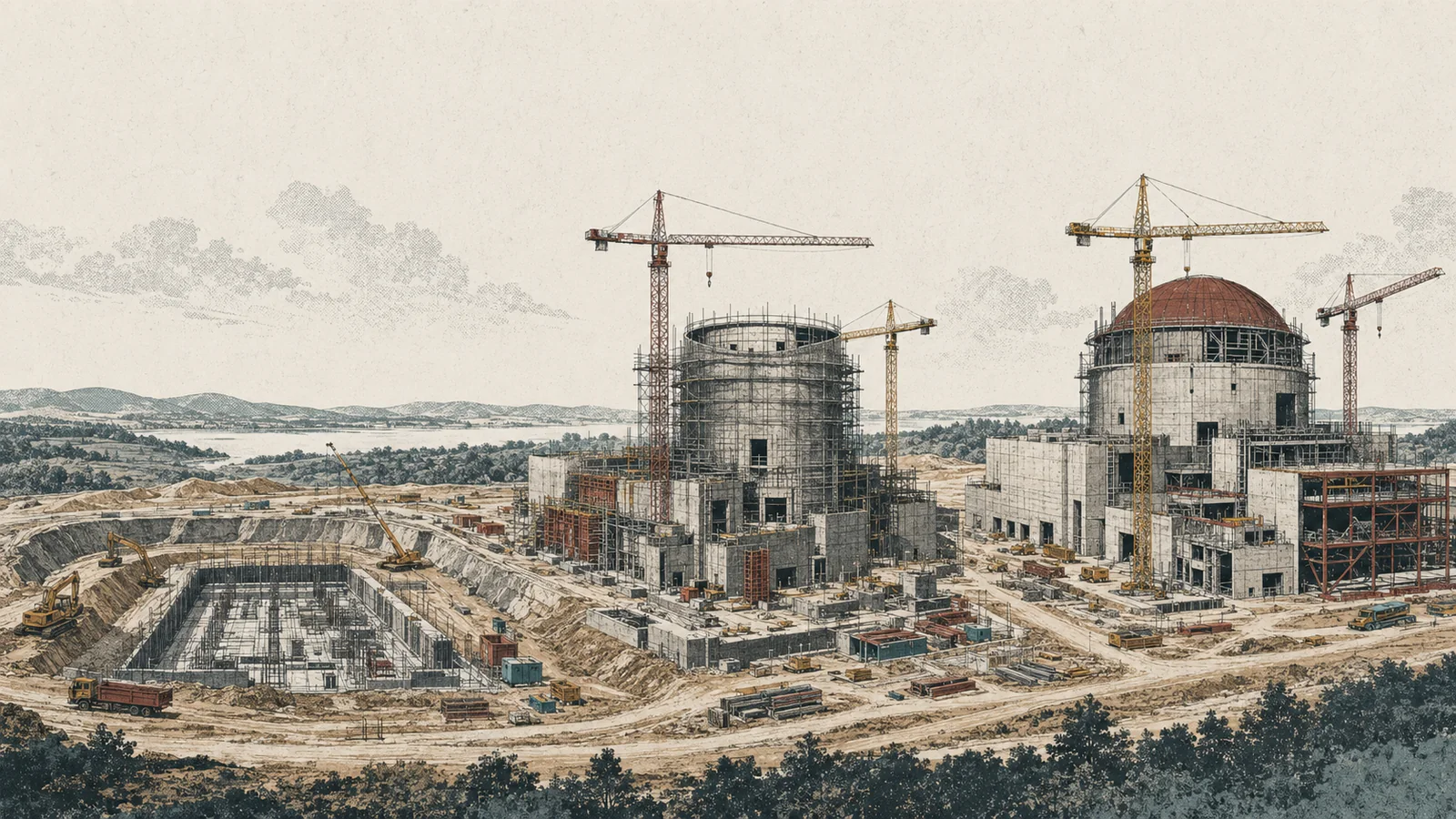
We are concerned here with expansion, particularly new reactors in Europe and North America. We are not claiming that nuclear power is high-carbon, or that every existing reactor should shut now. Continued operation and lifetime extensions need their own case-by-case review.

The case for nuclear power

Nuclear power has genuine advantages that a fair assessment must include.

We do not dispute these advantages. The question is whether they outweigh the build time, financing risk and long-term obligations of a particular new project, and whether that project performs better than realistic alternatives.

  • Its greenhouse-gas emissions over the full life cycle are low.
  • Reactors provide largely weather-independent power and often achieve high annual availability.
  • Their land use is relatively low for the amount of electricity generated.
  • Uranium is compact and easier to stockpile than natural gas.

When nuclear power can make sense

Nuclear power can be a reasonable choice when the conditions at a particular site are right.

  1. A safe existing plant can continue operating at an acceptable cost.

  2. A country repeatedly builds the same proven design with skilled workers, established suppliers and an experienced regulator.

  3. An independent whole-system comparison shows that the reactor can meet the climate target on time and at competitive total cost.

  4. Financing, liability, fuel supply, decommissioning and waste disposal are transparently arranged for the full lifetime.

The complete evidence dossier

Build time and financing are the core case. The remaining cards examine system questions, long-term obligations and additional risks.

  1. Core argument Cost

    New reactors put taxpayers and investors on the hook

    New large reactors need huge sums upfront, then years of financing before they sell any power. The IPCC found that first-of-a-kind projects in North America and Europe took more than 13 years to build and cost three to four times their original budgets.

    Modern reactors can technically follow changes in demand. The OECD/NEA nevertheless calls steady baseload operation the most economical mode: reducing output cuts electricity sales while most financing and fixed operating costs continue.

    Why it matters for new builds

    When climate budgets are limited, projects with more reliable costs and completion dates should come first.

    What to keep in mind

    Existing reactors are a separate case and can be cost-competitive. The construction record also varies by region. Standardised projects in East Asia have been faster, so overruns are not inevitable. Flexible nuclear operation is technically possible and can support the grid.

    Sources (4)
    1. IPCC AR6 WGIII, Chapter 6: Energy Systems Section 6.4.2.4 covers construction times, project overruns, upfront investment and regional counterexamples.
    2. IEA, The Path to a New Era for Nuclear Energy (2025) The executive summary covers financing, delivery risk, fuel-cycle concentration and conditional SMR scenarios.
    3. IEA, Nuclear Power and Secure Energy Transitions (2022) The executive summary assesses the economics of extending existing reactors separately from new construction.
    4. OECD/NEA, Technical and Economic Aspects of Load Following with Nuclear Power Plants (2021) The abstract and report explain that reactors can follow load, while steady baseload operation remains the simplest and most economical mode.
  2. Core argument Time

    Build time matters for the climate

    A reactor only starts avoiding emissions after it connects to the grid. The IPCC reports five to six years for many recent East Asian builds, but more than 13 years for first-of-a-kind projects in North America and Europe.

    Delivery also depends on specialist workers and suppliers that cannot be expanded overnight. In the IEA’s 2025 survey, more than half of energy organisations reported critical hiring bottlenecks; in nuclear roles, 1.7 workers were nearing retirement for every young entrant.

    Why it matters for new builds

    If proven clean power can be built sooner, new nuclear will do less to cut emissions in the near term.

    What to keep in mind

    A standardised nuclear programme with an established supply chain could still help over the longer term. Our point is about what to build first, not whether a reactor has value over its full life.

    Sources (3)
    1. IPCC AR6 WGIII, Chapter 6: Energy Systems Section 6.4.2.4 covers construction times, project overruns, upfront investment and regional counterexamples.
    2. IEA, The Path to a New Era for Nuclear Energy (2025) The executive summary covers financing, delivery risk, fuel-cycle concentration and conditional SMR scenarios.
    3. IEA, World Energy Employment 2025, Executive Summary The executive summary reports hiring bottlenecks, shortages in nuclear engineering and the 1.7-to-one retirement ratio in nuclear roles.
  3. Decision factor Reliability

    Nuclear fleets can lose several reactors at once

    Reactors often run at high annual availability. They are not immune to common failures. In 2022, stress-corrosion inspections, repairs and a maintenance backlog cut average availability across France’s fleet to 54%, down from 73% in 2015–2019.

    Heat brought a different shared constraint in June and July 2026. Rules on river warming and thermal discharges caused total or partial unavailability at French riverside reactors. RTE measured an effective availability loss of up to about 8 GW in late June and about 9 GW around mid-July.

    Why it matters for new builds

    A grid with many similar large reactors needs enough reserves, interconnection and replacement power to cover rare but large outages.

    What to keep in mind

    France kept the lights on in 2022, and the fleet recovered. RTE reports 74.0% availability and 373.0 TWh of nuclear generation in 2025, close to pre-crisis levels. RTE says the 2026 heat-related production loss stayed limited relative to total fleet output, and France maintained positive margins. Exposure differs by site and cooling system.

    Sources (3)
    1. RTE, French Annual Electricity Review 2025 The nuclear section gives 54% fleet availability in 2022, 74.0% in 2025, 373.0 TWh of generation in 2025, the causes and the system effects.
    2. RTE, First-Half 2026 Electricity System Review PDF pp. 22–23, following Figure 10, covers the June–July heat-related loss of effective nuclear availability, thermal-discharge limits and system margins.
    3. IAEA PRIS, World Trend in Energy Availability Factor Global reactor availability data. Accessed 16 July 2026.
  4. Decision factor Grid reserves

    One large reactor failure becomes a system-wide event

    Power systems keep fast reserves for their largest credible sudden loss. In its 2013 supporting document, ENTSO-E based Continental Europe’s 3,000 MW reference incident on two 1,500 MW nuclear units. A 2025 British study found that Hinkley Point C can create a contingency of up to 1.8 GW, compared with 1.32 GW for Sizewell B.

    Why it matters for new builds

    The larger a single block becomes, the more reserve capacity the whole system must keep ready for its abrupt loss.

    What to keep in mind

    This is not unique to nuclear power. Large interconnectors and offshore wind connections can also set the largest contingency, and batteries can provide fast reserves. Running reactors also contribute rotational inertia.

    Sources (2)
    1. ENTSO-E, Supporting Document for the Network Code on Load-Frequency Control and Reserves (2013) PDF pp. 57 and 109–110 explain the 3,000 MW reference incident and its basis in two 1,500 MW nuclear units.
    2. Badesa, Matamala and Strbac, Energy Policy 196 (2025), 114379 The Great Britain case study compares a Hinkley Point C contingency of up to 1.8 GW with 1.32 GW for Sizewell B.
  5. Decision factor Cooling water

    Cooling a reactor puts pressure on rivers and aquatic life

    An NREL review found that cooling design can matter more than fuel type. Once-through systems withdraw 10 to 100 times more water per unit of electricity than recirculating systems, while recirculating systems consume at least twice as much. The U.S. EPA says intake structures can kill or injure fish, shellfish and their eggs.

    Why it matters for new builds

    A thermal power station’s cooling burden arises whenever the plant operates and is felt locally, even when its electricity is low-carbon.

    What to keep in mind

    Withdrawal is not the same as consumption: most once-through water is returned. Seawater, recirculating and dry cooling can reduce particular impacts, but involve different costs, water losses and performance trade-offs.

    Sources (2)
    1. NREL, A Review of Operational Water Consumption and Withdrawal Factors for Electricity Generating Technologies (2011) Executive summary and pp. 7–14 distinguish water withdrawal from consumption and compare cooling configurations.
    2. U.S. EPA, Cooling Water Intakes Explains impingement and entrainment of fish, shellfish and eggs at cooling-water intakes.
  6. Decision factor Imports

    Nuclear power does not end import dependence

    A reactor does not need a gas pipeline, but it still needs uranium and services for conversion, enrichment and fuel fabrication. In 2025, Russia supplied about 16% of uranium, 24% of conversion services and 23% of enrichment services delivered to EU utilities.

    Why it matters for new builds

    A reactor built at home is not the same as a domestic fuel supply.

    What to keep in mind

    Uranium is compact and easy to stockpile, so this is not the same risk as imported gas. At the end of 2025, EU utilities held enough inventory for more than three reactor reloads on average. Canada was the largest uranium supplier.

    Sources (2)
    1. Euratom Supply Agency, Market Observatory (2025 data) EU uranium origin, conversion, enrichment, fuel-fabrication vulnerabilities and utility inventories. Accessed 16 July 2026.
    2. IEA, The Path to a New Era for Nuclear Energy (2025) The executive summary covers financing, delivery risk, fuel-cycle concentration and conditional SMR scenarios.
  7. Decision factor Uranium mining

    Uranium mining leaves a long-lived waste stream

    The IAEA says uranium tailings can retain up to 85% of the ore’s initial radioactivity and also contain heavy metals and other potentially harmful compounds. A pooled study of uranium miners in North America and Europe found elevated lung-cancer mortality, with a smaller excess among workers hired in 1965 or later.

    Why it matters for new builds

    The fuel cycle moves part of nuclear power’s environmental and occupational-health burden away from the power station.

    What to keep in mind

    Much of the health evidence reflects historical working conditions. Modern ventilation, exposure monitoring, lined facilities and stronger regulation can substantially reduce risk, but tailings still require long-term containment.

    Sources (2)
    1. IAEA, Occupational Radiation Protection in the Uranium Mining and Processing Industry (2020) Section 6.9, pp. 101–102, covers tailings radioactivity, heavy metals, chemical hazards and long-term containment.
    2. Richardson et al., Mortality among uranium miners in North America and Europe, International Journal of Epidemiology (2021) The abstract and Table 3 report mortality patterns for pooled uranium-miner cohorts, including the lower lung-cancer excess among later hires.
  8. Decision factor Security

    War creates hazards that last for decades

    War can damage power lines, interrupt access to electricity and cooling, restrict maintenance and put staff under severe pressure. In February 2026, the IAEA reported two more total losses of off-site power at Zaporizhzhia. Enrichment and reprocessing raise a separate concern because both are proliferation-sensitive.

    Why it matters for new builds

    A reactor and its spent fuel need protection for decades, including during shutdown, political instability and war.

    What to keep in mind

    A reactor cannot explode like a nuclear bomb, and an attack does not automatically cause a meltdown. Civilian operation is not a weapons programme. International safeguards are designed to verify peaceful use.

    Sources (3)
    1. IAEA, Nuclear Safety, Security and Safeguards in Ukraine, GOV/2026/7 PDF p. 6, paragraph 14, records two total losses of off-site power at Zaporizhzhia on 6 and 13 December 2025.
    2. IAEA, Technical Features to Enhance Proliferation Resistance of Nuclear Energy Systems (2010) Section 2, printed p. 7 (PDF p. 17), explains why enrichment and civilian reprocessing facilities or technologies are proliferation-sensitive.
    3. IAEA, Safeguards and Verification Explains how international safeguards verify that nuclear material and technology remain in peaceful use.
  9. Decision factor Accidents

    Rare accidents can disrupt whole regions

    UNSCEAR recorded about 118 thousand evacuees after Fukushima, including people evacuated for reasons other than the nuclear emergency. The WHO reports no acute radiation injuries or deaths from radiation exposure, while evacuation and relocation caused broad social, economic and public-health harm.

    Why it matters for new builds

    Even with a low probability, evacuation, lost homes, clean-up and compensation can affect communities far beyond the plant for years.

    What to keep in mind

    Fukushima does not establish the accident probability of a modern reactor; that depends on design, site, operation and emergency preparedness. The evidence does not support claims of mass radiation deaths at Fukushima.

    Sources (2)
    1. UNSCEAR 2013 Report, Volume I, Scientific Annex A Scientific Annex A, paragraph 76, records precautionary and deliberate evacuation and explains the approximate total.
    2. WHO, Health consequences of the Fukushima nuclear accident (2016) The public-health section distinguishes radiation effects from the social and health consequences of evacuation and relocation.
  10. Decision factor Liability

    The full accident risk is not in the insurance policy

    The revised Paris Convention sets operator liability at a minimum of €700 million. Under the Brussels system, public funds complement the available compensation to at least €1.5 billion. Germany’s current rules require financial security of up to €2.5 billion.

    Why it matters for new builds

    The amount secured in advance is not the same as the financial loss a severe regional accident could create; government and society retain part of the risk.

    What to keep in mind

    National rules vary, and €700 million is a minimum rather than a universal maximum. Strict, channelled liability gives claimants a single liable operator, and states can require more cover.

    Sources (2)
    1. OECD/NEA, New treaties to strengthen rights of people affected by nuclear accidents (2022) Explains the €700 million operator minimum and the public tiers that bring available compensation to at least €1.5 billion.
    2. German Federal Ministry of Justice, Section 9 of the Nuclear Financial Security Ordinance Section 9 sets mandatory financial security for reactors at up to €2.5 billion.
  11. Decision factor Waste and dismantling

    Waste and dismantling outlast the reactor

    The IAEA reported in 2024 that no geological repository for high-level waste or spent fuel was operating. In March 2026, Finland’s Posiva facilities at Olkiluoto were still under operating-licence review.

    For three EU decommissioning programmes involving older, early-closed reactors, the European Court of Auditors found that cost estimates rose 40% from €4.1 billion in 2010 to €5.7 billion in 2015, leaving a €1.7 billion funding gap before final disposal.

    Why it matters for new builds

    A new reactor creates obligations that continue after it stops earning money, so funds and institutions must remain adequate for decades.

    What to keep in mind

    The science supports deep geological disposal, and well-designed funds can internalise future costs. The audited reactors were unusual legacy projects, not a forecast for every modern plant. Repositories still have to be licensed, built and operated.

    Sources (4)
    1. IAEA, Roadmap for Implementing a Geological Disposal Programme (2024) Section 1.1, printed p. 2 (PDF p. 12), states that no geological repository for high-level waste, including spent fuel, was operating at publication.
    2. STUK, Finland’s national-report questions and answers (2026) Article 19, reference 125 (PDF p. 4), says Posiva’s facilities at Olkiluoto were under operating-licence review.
    3. U.S. NRC, Backgrounder on Radioactive Waste Defines spent reactor fuel and high-level radioactive waste and describes their current management.
    4. European Court of Auditors, EU nuclear decommissioning assistance programmes (2016) Paragraphs 72–85 and 113–115 document revised cost estimates and the funding gap, excluding final disposal.
  12. Decision factor Small reactors

    SMRs have not proved their case at scale

    SMRs already operate in Russia and China. What is missing is a track record of repeatable, competitively priced deployment. The promised savings depend on standard designs, factory production and a large order book, while smaller reactors lose some economies of scale.

    Why it matters for new builds

    Governments should judge SMRs by completed projects, not savings that still depend on mass production and future cost reductions.

    What to keep in mind

    Smaller projects may be easier to finance and could find useful roles. The IEA’s stronger scenarios assume government support, faster regulation, successful delivery and large cost reductions.

    Sources (3)
    1. IPCC AR6 WGIII, Chapter 6: Energy Systems Section 6.4.2.4 covers construction times, project overruns, upfront investment and regional counterexamples.
    2. IAEA Expands Global Initiative to Boost Knowledge of Small Modular Reactors (4 August 2025) Reports global SMR developments, including operating units in China and Russia.
    3. IEA, The Path to a New Era for Nuclear Energy (2025) The executive summary covers financing, delivery risk, fuel-cycle concentration and conditional SMR scenarios.

How we work

We argue that Europe should not make new reactors a climate priority. We accept that nuclear power has low life-cycle emissions and that some existing plants are worth keeping open. Each argument links to the underlying evidence, says where and when it applies, and explains our conclusion. We also include facts that count against our case. If a source is wrong or out of date, please tell us.